

Why Does a 1/5th Share Cost More Than 1/5th of the Home?
By Karla Jones | Owner, Luxury Fractional Guide

Today’s Question
“If a $2 million vacation home is divided into five shares, shouldn’t each 1/5 interest cost
$400,000?”
Mathematically, yes.
But that doesn’t necessarily mean $400,000 will be the price of the fractional share.
Buyers sometimes look at the value of the underlying home, divide it by the number of shares and discover that the asking price is considerably higher. That leads to the question I think every fractional buyer should ask:
What exactly am I paying for above my pro-rata share of the real estate?
Not Every Dollar Above the Real Estate Is a Markup
There are legitimate costs involved in creating a co-ownership. The home may need furnishings or improvements. Attorneys may need to create the ownership structure and governing documents. There are closing and acquisition costs. The new ownership may also need initial reserves so the owners aren’t starting with an empty bank account.
Those costs generally benefit the property or the ownership group.
Then there’s another category: the cost of creating, marketing and selling the fractional offering itself.
Depending on the company, you may see this described as a sponsor fee, subscription fee, acquisition fee, service fee or buyer aggregation fee. That money generally isn’t going into the reserve account or buying furniture. It’s compensation for the company that found the property, structured the offering, assembled the buyers and brought the fractional to market.
There’s nothing inherently wrong with that. But you should know how much you’re paying for it.
Here’s What a Simple Co-Ownership Can Look Like
I recently created a preliminary pricing model for a five-owner Hilton Head Island co-ownership.
The home was priced at $2.5 million. Divide that among five owners and the underlying real estate is $500,000 per 1/5 share.
We then budgeted $20,000 for initial reserves, $100,000 for interior design and furnishings, and $15,000 for legal, ownership setup and LFG’s advisory and marketing work. That brought the total initial capitalization to $2.635 million, or approximately $527,000 per 1/5 share.
That’s about 5.4% above the underlying value of the real estate.
The additional $135,000 had a defined purpose. Most importantly, $20,000 of that money remained in the ownership as reserves.
Now Look at a Sponsored Fractional
I’ve also worked with professionally sponsored fractional models where the economics looked very different.
In one offering, the sponsor charged a separate 10% subscription fee, in addition to reserves, furnishings and improvements, closing costs and other acquisition expenses.
Pacaso currently describes an acquisition or service fee of around 12% at closing, with that fee covering items that include LLC formation, onboarding and buyer aggregation. A professionally sponsored fractional may provide considerable value. The sponsor may find the property, create the legal structure, furnish it, assemble the owners, establish the reservation system and arrange ongoing management.
But those services have a price. And that price can create a meaningful difference between the value of the real estate you’re acquiring and the price you’re paying for your fractional share.
Do the Math Before you Buy
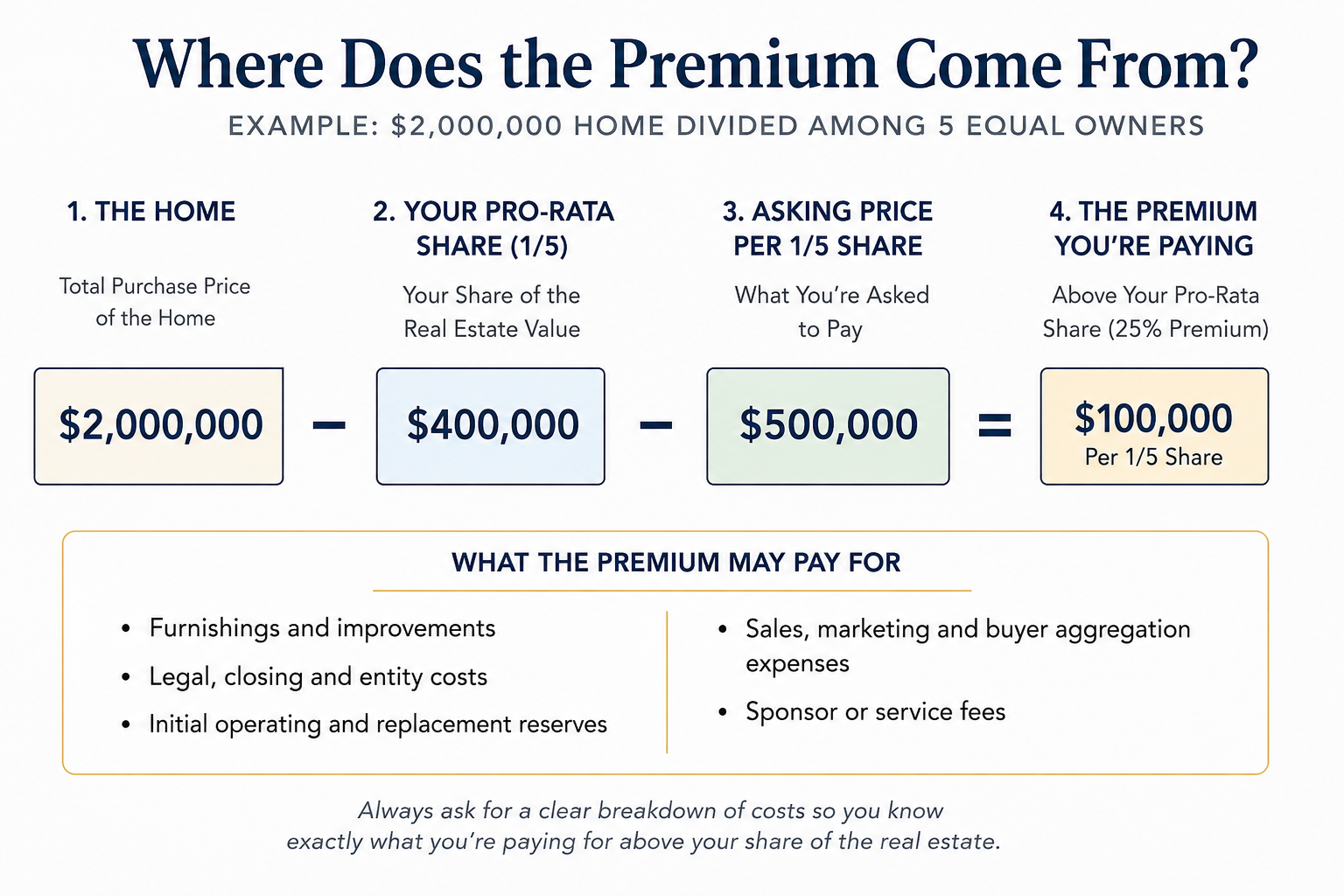
Suppose a $2 million home is divided among five owners and each share costs $500,000.
Buyers are collectively paying $2.5 million for a $2 million property.
Where does the additional $500,000 go?
There’s Another Way to Create a Fractional Offering
You don’t necessarily need a large fractional sponsor to create a well-structured co-ownership.
A homeowner may already own the right property and want to bring in two, three or four co-owners. Or several buyers may want to purchase a vacation home together.
Luxury Fractional Guide can help structure these private co-ownerships, including pricing, ownership percentages, reservation systems, operating budgets, reserves and governance, working with the appropriate legal and real estate professionals where needed.
Because you’re not necessarily paying a large sponsor to acquire the property, aggregate the buyers and market the shares, the cost of creating the co-ownership can be substantially lower.
If you own a vacation home and are considering bringing in co-owners, or you’re part of a group that wants to buy together, Luxury Fractional Guide be happy to help you think through the numbers and structure.